
How to Decode Neural Activity in Living Organisms using Quantum Sensors
Quantum sensors provide a step-function in performance over classical sensors and are ideal for medical applications because of their unique sensing capabilities. Quantum sensors are an order of magnitude (~10x) more sensitive to environmental changes than classical sensors thanks to the sensitivity of quantum states. Where classical sensors fail to detect infinitesimal changes in the environment, quantum sensors can pick them up with ease.
Goal: Decode neural activity in living organisms.
Approach: Use magnetoencephalography (MEG) to measure tiny magnetic fields generated by neural activity. Highly sensitive quantum MEGs can read signals even while we’re moving, opening the door to brain-computer interfaces. MEGs have been designed that operate at room temperature.
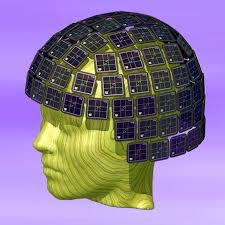
Sources: C. Wan, "Exploring the quantum triad: Quantum sensing" and CEA-LETI, "Quantum sensors, measurement devices with unrivaled precision"

Comments